Complex Exponential Diagonalizes Translation
Fourier analysis and more generally Harmonic Analysis is concerned with the problem of doing analysis on a space of functions which a group acts upon. The main task is to find functions that transform in simple ways under the group action and use these as the basis.
To be more concrete, consider two types of space of numbers of interest:
- Periodic Domain \(\mathbb{T}^n=\{z \in \mathbb{C} : |z|=1\}^n= \mathbb{R}^n/\mathbb{Z}^n\)
- Nonperiodic Domain \(\mathbb{R}^n\)
For functions on \(\mathbb{T}^n\) or \(\mathbb{R}^n\), we are interested in the translation: \(\tau_x f(y)=f(x+y)\) We note that :
- For functions on \(\mathbb{T}^n\), the translation is the group action of \((\mathbb{T}^n,+)\) on the space of functions
- For functions on \(\mathbb{R}^n\), the translation is the group action of \((\mathbb{R}^n,+)\) on the space of functions
Turns out functions that diagonalizes the translation opeartor is very nice. Consider the eigenvalue problem:
Example 1. Find \(f\) such that there exists a function \(\phi(x)\) with \(\forall x, |\phi(x)|<1\)
\[\tau_x f(y) = \phi(x) f(y)\]We note the eigenvalue must satisfy:
\[\phi(x)\phi(y) = \phi(x+y)\]since:
\[\begin{align*} \phi(x)\phi(y)f(0) &= \phi(x)f(y) \\ &= f(x+y) \\ &= \phi(x+y)f(0) \end{align*}\]This suggests that \(\phi(x)=e^{2\pi i \xi \cdot x}\) which implies the eigenvectors(eigenfunctions) must also be \(f(y)=e^{2\pi i \xi \cdot y}\)
Turns out:
Theorem 1.
\(\{e^{2\pi i \kappa \cdot x}: \kappa \in \mathbb{Z}^n\}\) forms an orthonormal basis of \(L^2(\mathbb{T}^n)\)
but on non-periodic domain we don’t get lucky. However they still form some kind of building block for \(L^1(\mathbb{R}^n)\), we will denote them by
\[\{e^{2\pi i\xi \cdot x} : \xi\in \mathbb{R}^n\}\]Shwartz Space
We first need a nice enough space of functions to operate in. The ideal function space for doing Fourier Aanlysis is called Shwartz Space, denoted by \(\mathcal S\). In plain english:
Definition 1. Shwartz space consists all \(C^{\infty}\) functions, together with their derivatives, vanish at infinity faster than any power of \(|x|\)
Now to state this mathematically, we would need to consider mixed partial derivatives of higher order, which is cumbersome to write them explicitly. A common shortcut in notation is multi-indexing
Definition 2. A multi-index is an orderd \(n\)-tuple of nonnegative integers \(\alpha = (\alpha_1,...,\alpha_n)\). We denote the mixed derivative as:
\[\partial^{\alpha} := \partial_{x_1}^{\alpha_1}..\partial_{x_n}^{\alpha_n}\]Also, for a variable \(x=(x_1,...,x_n)\), we denote
\[x^{\alpha} := x_1^{\alpha_1}x_2^{\alpha_2}\cdots x_n^{\alpha_n}\](if one is familiar with how numpy broadcasting work, this is exactly the same rule)
| We also denote $$ | \alpha | =\sum_{\alpha_j}$$ to be the order of the multi-index. |
This allows us to define Shwartz Space formally:
Definition 3. For any nonnegative integer \(N\) and any multi-index \(\alpha\), define:
\[\|f\|_{(N,\alpha)}=\sup_{x \in \mathbb{R}^n} (1+|x|)^{N}|\partial^{\alpha} f(x)|\]Now define the Shwartz Space as:
\[\mathcal S = \{f\in C^{\infty} : \sup_{N,\alpha} \|f\|<\infty\}\]Proposition 1.
\[\mathcal S(\mathbb{R}^n) \subset L^p(\mathbb{R}^n)\]Fourier Transform
Definition 4. On periodic domain, define the Fourier Transform as:
\[\hat{f} (\kappa) = \int_{\mathbb{T}^n}f(x)e^{-2\pi i \kappa \cdot x} dx\]where \(\kappa \in \mathbb{Z}^n\). The Inverse Fourier Transform is
\[f = \int_{\mathbb{T}^n} \hat{f}(\kappa) e^{2\pi i \kappa \cdot x }d\kappa\]For non-periodic domain:
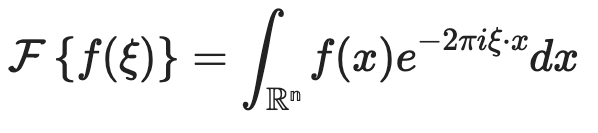
\[\hat{f} (\xi) = \int_{\mathbb{R}^n}f(x)e^{-2\pi i \xi \cdot x} dx\]where \(\xi\in \mathbb{R^n}\). The Inverse Fourier Transform is
\[f (x) = \int_{\mathbb{R}^n}\hat{f}(x)e^{2\pi i \xi\cdot x} d\xi\]Rmk. It is also conventional to make a change of varialbe \(\xi_{\text{new}} \gets 2\pi \xi_{\text{old}}\) define:
\[\widehat {f}(\xi) = \frac{1}{(2\pi)^{n/2}}\int_{\mathbb{R}^n} e^{-ix\cdot \xi_{\text{new}}}f(x)dx\]and
\[{f}(\xi) = \frac{1}{(2\pi)^{n/2}}\int_{\mathbb{R}^n} e^{ix\cdot \xi}\hat f(\xi)d\xi\]We will primarily use the second convention when solving PDE/ODE
Note that the convergence of the integral is guaranteed if \(f\in L^1\) since \(|e^{\pm 2\pi i \xi \cdot x }|=1\) (recall \(\{e^{i\theta}, \theta \in \mathbb{R}\}\) is the unit circle) and \(f\in L^1\) implies that
\[\| f \|_{L^1} = \int_{\mathbb{R}^n} |f| dx < \infty\]Let’s now consider some examples
1. \(f(x)=\frac{1}{1+x^2}\)
Consider the integration on \(\mathbb{C}\), recall Cauchy’s Residue Theorem:
Definition 5. If you integrate a smooth complex function around a closed loop that contains poles, if we fix positive orientation(counter-clockwise):
\[\oint _{C}f(z)\,dz=2\pi i\sum _{k=1}^{n}\text{Res}(f,z_{k})\]Simiarily, if we fix negative orientation(clockwise):
\[\oint _{C}f(z)\,dz=-2\pi i\sum _{k=1}^{n}\text{Res}(f,z_{k})\]For a simple pole:
\[\text{Res}(f,z_{0}) = \lim_{z \to z_0} (z - z_0) f(z)\]Now consider the following integration path:
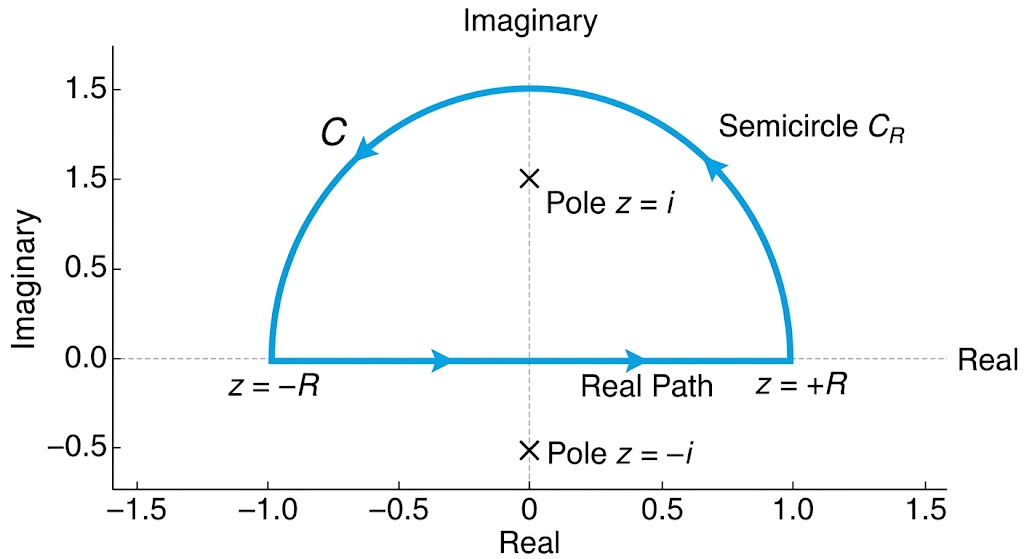
We can split the integral into two parts and the desired integral can be found on the real axis when \(R\to \infty\):
\[\begin{align*} \int_C \frac{e^{- i\xi z}}{1+z^2}dz &= \int_R^R \frac{e^{- i\xi z}}{1+z^2}dz + \int_{C_R} \frac{e^{- i\xi z}}{1+z^2}dz \end{align*}\]We note that the integrand
\[\frac{e^{- i\xi z}}{1+z^2} = \frac{e^{- i\xi (x+iy)}}{1+z^2}=\frac{e^{-i\xi x} e^{i\xi y}}{1+z^2}\]decays exponentially as \(y\to \infty(R\to \infty)\) if \(\xi < 0\). In that case,
\[\begin{align*} \int_R^R \frac{e^{- i\xi z}}{1+z^2}dz &= \int_{C_R} \frac{e^{- i\xi z}}{1+z^2}dz \\ &= 2\pi i \mathrm{Res}(f, i) \\ &= 2\pi i \lim_{z \to i} \left((z-i)\frac{e^{-i\xi z}}{(z+i)(z-i)}\right) \\ &= 2\pi i \lim_{z \to i} \left(\frac{e^{-i\xi z}}{(z+i)}\right) \\ &= \pi e^{\xi} \end{align*}\]Similarily, for \(\xi > 0\) we can pick the semicircle to be in the negative half-plane to enclose \(z_0=-i\) and traverse in clockwise direction. We would have:
\[\begin{align*} \int_R^R \frac{e^{- i\xi z}}{1+z^2}dz &= \int_{C_R} \frac{e^{- i\xi z}}{1+z^2}dz \\ &= -2\pi i \mathrm{Res}(f, -i) \\ &= -2\pi i \lim_{z \to -i} \left((z+i)\frac{e^{-i\xi z}}{(z+i)(z-i)}\right) \\ &= -2\pi i \lim_{z \to -i} \left(\frac{e^{-i\xi z}}{z-i}\right) \\ &= \pi e^{-\xi} \end{align*}\]Hence we have
\[\int_R^R \frac{e^{- i\xi z}}{1+z^2}dz = \pi e^{-|\xi|}\]The integral is independent of \(R\) hence taking \(R\to \infty\) gets desired integral. The fourier transform is hence:
\[\mathcal F\left\{\frac{1}{1+x^2}\right\}=\sqrt{\frac{\pi}{2}}e^{-|\xi|}\]Likewise since \(1/(1+x^2)\) is even we have:
\[\mathcal F^{-1}\left\{\frac{1}{1+\xi^2}\right\}=\sqrt{\frac{\pi}{2}}e^{-|x|}\]2. Fourier Transform of Gaussian
This is an instrumental piece of computation, so we register it as a lemma.
Lemma 1.
\[\int_{\mathbb{R}^n} e^{-t|x|^2}e^{ix\cdot \xi} dx = \left(\frac{\pi}{t}\right)^{n/2} e^{-\frac{|\xi|^2}{4t}}\]Since the gaussian is an even function, the substitution \(\xi \to -\xi\) yields the same result. Hence the above implies:
\[\begin{align*} \mathcal F \left\{ e^{-t|x|^2}\right\} &= \left(\frac{1}{2t}\right)^{n/2}e^{-\frac{i|\xi|^2}{4t}} \\ \mathcal F^{-1} \left\{ e^{-t|\xi|^2}\right\} &= \left(\frac{1}{2t}\right)^{n/2} e^{\frac{-i|x|^2}{4t}} \\ \end{align*}\]Properties of Fourier Transform
We summarize the elementary properties of \(\mathcal F\)
Proposition 2.
Suppose \(f\in L^2(\mathbb{R}^n)\)
- Taking derivative in fourier space is multiplication by polynomial
- Convolution is just multiplication
proof: (1) We first assume \(f \in C^{\infty}_0(\mathbb{R}^n)\). Then we can integrate by part:
\[\begin{align*} \widehat{\partial^\alpha f} (\xi) &= \int_{\mathbb{R}^n} e^{-ix\cdot \xi} \left(\partial^\alpha f(x) \right)dx \\ &= (-1)^{|\alpha|}\int_{\mathbb{R}^n} \partial^\alpha (e^{-ix\cdot \xi}) f(x) dx \\ &= (-1)^{|\alpha|} (-i \xi )^{\alpha} \int_{\mathbb{R}^n}e^{-ix\cdot \xi} f(x) dx \\ &= (i\xi)^{\alpha} \widehat{f}(\xi) \end{align*}\]By the density of \(C^{\infty}_0(\mathbb{R}^n)\) in \(L^2(\mathbb{R}^n)\) we can pick \(\{f_j\}_{j=1}^{\infty} \longrightarrow f\) where \(f_j\in C^{\infty}_0(\mathbb{R}^n)\)
The Inversion Theorem
Applications
Solving ODEs
Problem 1.
\[-y''+y=f\]Now let’s consider solving the heat equation, schrodinger equation and wave equation.
Fundamental solution of Heat equation
Problem 2.
Consider the IVP:
\[\begin{cases} u_t - \Delta u =0 \quad \mathbb{R}^n\times (0,\infty) \\ u = g \quad \mathbb{R}^n\times \{t=0\} \end{cases}\]We fourier transform the equation spatially and initial conditions. To do so we first compute the fourier transform of the laplacian \(\Delta = \sum_j \frac{\partial^2 }{\partial_j^2}\). This is a sum of derivatives with \(\alpha_j = (0,0,...,2,0,...,0) = (2\delta_{ij})_i\). Hence:
\[\Delta = \sum_j \frac{\partial^2}{\partial_j^2} = \sum_j (i\xi)^2 = -|\xi|^2\]where \(|\cdot|\) denotes the 2-norm. Hence
\[\begin{cases} \hat{u_t} + |\xi|^2 \hat{u} =0 \quad t>0 \\ \hat{u} = \hat g \quad \{t=0\} \end{cases}\]Solving the ODE gets us:
\[\hat{u} = \hat{g}e^{-|\xi|^2t}\]Now by convolution theorem in Proposition 2 and Lemma 1 :
\[u = \mathcal F^{-1}\left\{\hat{g}e^{-|\xi|^2t} \right\} =\frac{g \ast \mathcal F^{-1}\{e^{-|\xi|^2t}\}}{(2\pi)^{n/2}} =\frac{1}{(2\pi)^{n/2}}\left[g \ast \left( \frac{1}{2t}\right)^{n/2} e^{-\frac{|x|^2}{4t}}\right]\]Write out the convolution explicitly:
\[\boxed{ u = \frac{1}{(4\pi t)^{n/2}} \int_{\mathbb{R}^n} e^{\frac{-|x-y|^2}{4t}}g(y) dy }\]- Rmk. We somtimes denote the map from the data \(g\) to the state at time \(t\) \(u(\cdot ,t)\) as \(e^{t\Delta}\), known as the propagator or time-evolution operator.
Fundamental solution of Schrödinger equation
Problem 3.
\[\begin{cases} iu_t - \Delta u =0 \quad \mathbb{R}^n\times (0,\infty) \\ u = g \quad \mathbb{R}^n\times \{t=0\} \end{cases}\]If we make the substitution \(t \gets it\) then the solution for heat equation is the solution for Schrödinger equation:
\[\begin{align*} u &= \frac{1}{(4\pi it)^{n/2}} \int_{\mathbb{R}^n} e^{\frac{-|x-y|^2}{4it}}g(y) dy \\ &= \frac{1}{(4\pi it)^{n/2}} \int_{\mathbb{R}^n} e^{\frac{i|x-y|^2}{4t}}g(y) dy \\ &= g \ast \left[\frac{1}{(4\pi it)^{n/2}} e^{\frac{i|x|^2}{4t}}\right] \end{align*}\]Definition 6.
We call
\[\Psi := \frac{1}{(4\pi it)^{n/2}} e^{\frac{i|x|^2}{4t}} \quad x\in \mathbb{R}^n, t\neq 0\]the fundamental solution of Schrödinger equation