Skip to article frontmatterSkip to article content
Site not loading correctly?

This may be due to an incorrect BASE_URL configuration. See the MyST Documentation for reference.

Stern-Gerlach Experiment

Consider the following experimental set up:
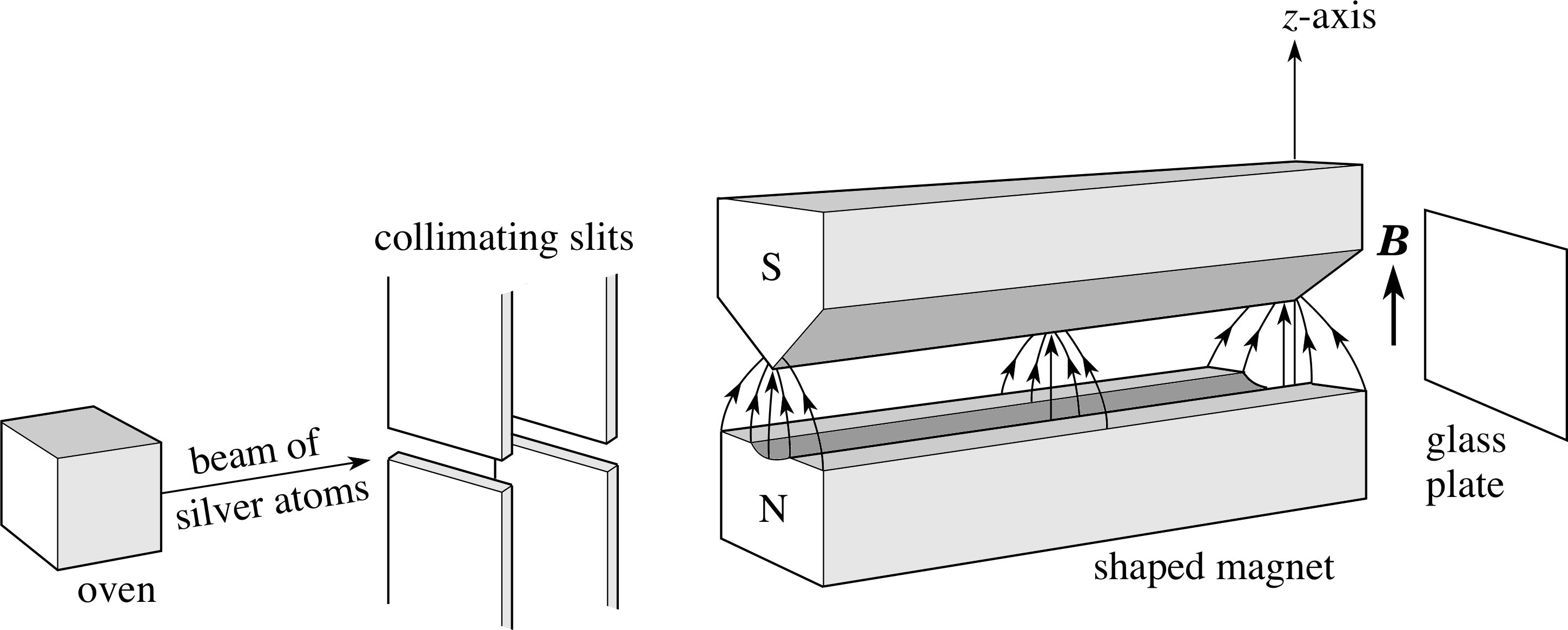
We want to know where would the silver atoms land on the glass plate. First we analyze through classical electromagnetics:

Since the energy is lowered if the dipole aligns with the magnetic field. As a result, the force experienced by the the dipole is simply:

∇U=−∇(μ⋅B)\nabla U=-\nabla(\boldsymbol{\mu}\cdot \mathbf{B})

In particular, we get that the zz component of the force is :

F(z)=−∂z(μ(z)Bx+μ(x)Bz+μ(y)By)\begin{align*} F^{(z)}&= -\partial_z (\mu^{(z)} B^{x}+ \mu^{(x)} B^{z} +\mu^{(y)} B^{y}) \end{align*}

In our case,